8618715108506
 manager@greensunpv.com
 solar Greensun




You choose a lithium battery storage system by defining your application objectives first, then evaluating four factors in order. Technical performance covers capacity, power, efficiency, and safety. Application fit matches the system to your load profile, available space, and future growth plans. Regulatory compliance confirms certifications, permits, and utility approval. Cost weighs upfront investment against lifetime value. Most commercial projects focus on peak shaving and energy arbitrage, backup power, or load management, so identify your primary objective early. This guide works as a practical checklist for project managers rather than an engineering manual. The sections below walk through each factor in turn.
Key Takeaways
-
Define your main goal first. Peak shaving, backup power, and load management require different system designs.
-
Use at least 12 months of interval data to size the battery correctly. Real operating data is more reliable than estimates.
-
Check relevant certifications such as UL 1973 and UL 9540. Confirm that the certificates apply to the battery or complete system being supplied.
-
Compare total cost of ownership, not just the purchase price. Include maintenance, replacement, and end-of-life costs.
-
Backup power may require a transfer switch and a dedicated backup panel. A battery alone does not guarantee power during an outage.
Energy Storage Systems: Key Technical Specs
Capacity, Power, and Efficiency
Two ratings help determine what an energy storage system can do for your site. Kilowatts (kW) measure power, or the rate at which the system delivers electricity at a given moment. Kilowatt-hours (kWh) measure energy, or the total amount of electricity the battery stores. The U.S. Department of Energy makes the same distinction: energy capacity is measured in kWh or MWh, while power capacity is measured in kW or MW. Ask two straightforward questions: What equipment can the battery run? How long can it run?
| Measurement | What it tells you | Simple question |
|---|---|---|
| kW | Power available at one time | What can the battery run? |
| kWh | Total energy stored | How long can it run? |
A 10 kW system can deliver up to 10 kilowatts under its rated operating conditions. A 10 kWh battery stores 10 kilowatt-hours of energy. If that battery supplies a constant 10 kW load, its theoretical runtime is about one hour. At an average load of 2 kW, the theoretical runtime is roughly five hours. The basic calculation is: runtime in hours = usable capacity in kWh ÷ average load in kW. The same principle applies to a 100 kWh lithium-ion battery or a larger commercial storage unit. Actual runtime depends on usable capacity, load demand, inverter efficiency, operating conditions, and the battery's discharge limits.
Round-trip efficiency (RTE) affects how much stored energy can be used. The calculation is: RTE = energy output ÷ energy input × 100. If a battery system takes in 10 kWh and returns 8 kWh, its round-trip efficiency is 80%.
| Energy Input (kWh) | Energy Output (kWh) | Round-Trip Efficiency (%) |
|---|---|---|
| 10 | 8 | 80 |
| 100 | 90 | 90 |
Lithium iron phosphate (LiFePO4 or LFP) battery systems can offer high round-trip efficiency, with actual results depending on the cells, inverter, battery management system, and operating conditions. When comparing suppliers, evaluate the efficiency of the complete storage system rather than relying only on individual cell specifications. For commercial projects, also check whether the quoted efficiency is measured at the battery DC level or at the AC system level.
Lifespan, Safety, and Chemistry
LFP is a widely used battery chemistry for stationary energy storage. Under suitable operating conditions, LFP batteries can provide thousands of charge and discharge cycles, with actual cycle life depending on depth of discharge, temperature, charging strategy, and cell quality. LFP chemistry also offers good thermal stability compared with some other lithium-ion chemistries. These characteristics make it a common option for commercial and industrial energy storage projects. However, battery life and safety still depend on cell quality, battery management, system design, and correct installation. Compare complete system performance rather than relying on one specification.
Certifications should be part of your safety review. Look for UL 1973 for stationary battery applications, UL 9540 for the complete energy storage system, UL 9540A for thermal runaway fire propagation testing, and IEC 62619 for industrial lithium-ion batteries. CE marking is relevant for products placed on the European market, while TÜV and CSA certifications may provide additional evidence of testing and compliance. Always verify the certificate number, product model, issuing organization, and whether the certificate covers the cells, battery pack, or complete system.
Commercial & Industrial Battery Backup Systems: Application Fit
Load Profile, Space, and Scalability
Start with your project objective because it determines many of the decisions that follow. Peak shaving and peak-valley arbitrage use stored electricity to reduce grid consumption during expensive or high-demand periods. The battery charges when electricity is cheaper or when surplus solar power is available, then discharges when electricity prices or site demand increase. An energy management system (EMS) can review time-of-use tariffs, site load, solar output, and battery state of charge to determine suitable charging and discharging periods. Backup power and load management follow different design requirements. A battery alone does not guarantee backup during a grid outage. The system may need an appropriate transfer mechanism and a dedicated backup panel, while inverter power ratings and load priorities determine which equipment can remain operational.
Design around real operating data rather than assumptions. Collect 15-minute interval data for at least 12 months where available, then review demand charges, time-of-use energy rates, and any demand response arrangements. A proper BESS evaluation should consider the trade-offs among energy charges, peak demand charges, and coincident peak demand. System sizing should balance potential electricity bill savings against the initial investment. For example, a facility with 785 kW peak demand and a 1,000 kW solar array could evaluate different battery configurations, such as a 500 kW / 1,000 kWh BESS, under several operating scenarios before selecting a final design. This is an illustrative example rather than a universal sizing recommendation.
Available space and future expansion also influence hardware selection. Rack-mounted systems can be suitable when a project requires modular battery installation and centralized equipment management. Stackable battery modules may support phased capacity expansion. A lithium battery cabinet can help organize battery modules, wiring, and protection equipment in a dedicated equipment area. For larger commercial and industrial projects, high-voltage battery systems and outdoor cabinet solutions may be more appropriate for managing higher energy capacity and power requirements.
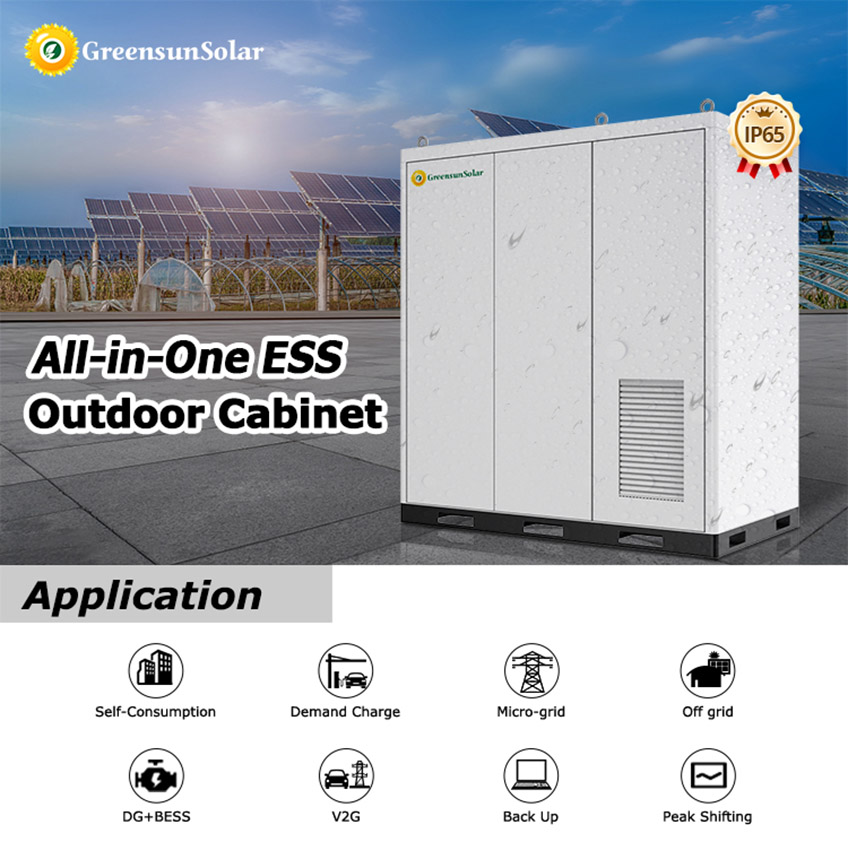
GREENSUN all-in-one outdoor cabinet energy storage system
How to Choose the Right Lithium Battery Storage System
System integration determines whether the battery, inverter, and control equipment can work together reliably. Start by matching the battery voltage class to the inverter platform. Then confirm the communication protocol, connection method, and supported battery parameters. Check whether the inverter can read battery information such as state of charge, voltage, current, temperature, and protection status through the selected communication interface. Do not assume that batteries and inverters are compatible simply because they use the same nominal voltage. Compatibility should be confirmed for the exact models and firmware versions involved.
GREENSUN offers LFP battery options in 12V, 24V, 48V, and high-voltage configurations, giving project planners different options for residential, commercial, and industrial applications. Its commercial and industrial energy storage systems include cabinet-based solutions designed for larger energy storage requirements. When evaluating a system, ask the supplier to confirm the supported inverter models, communication protocols, voltage range, and system configuration for your specific project.
Treat backup power as an engineering requirement rather than a simple checkbox. System sizing should begin with the intended application because a battery designed for short-duration grid services differs significantly from one intended to shift several hours of solar production. Define your critical load requirements, confirm the transfer and switching architecture, and calculate the runtime your operation needs. This approach helps turn a general commercial and industrial battery backup system into a solution that provides practical power resilience. A properly designed backup system can support essential operations during outages, provided its power capacity, usable energy, and switching equipment match the site's requirements.
BESS Compliance and Safety Standards
Safety Standards and Grid Interconnection
Build your compliance file before ordering hardware. Identify the standards that apply to each part of the system. IEC 62619 covers safety requirements for industrial lithium cells and batteries, UL 1973 applies to stationary battery applications, and UL 9540 addresses the complete energy storage system. UL 9540A provides a test method for evaluating thermal runaway fire propagation. NFPA 855 addresses the installation of stationary energy storage systems, while UN 38.3 covers lithium battery transport testing. Protection and control equipment may also need to comply with relevant IEC standards, depending on the system architecture and project requirements.
Utility interconnection approval follows a separate process. The utility may review voltage, frequency, power factor, reactive power, export limits, anti-islanding protection, ride-through capability, system protection, and communication functions. IEEE 1547 provides a framework for distributed energy resource interconnection in the United States, but individual utilities may have additional technical requirements and application procedures. Confirm grid code compliance during project planning, commissioning, and operation.
Permitting requirements can vary significantly by location. Some jurisdictions classify large energy storage installations as conditional or special uses, while others apply specific requirements for setbacks, fire access, noise, land use, and emergency response. Local authorities may also require site plans, fire protection documentation, environmental assessments, or additional technical reports. Verify local requirements before purchasing equipment or finalizing the project site. If the project involves a property transfer, check whether existing permits and approvals can be transferred to the new owner.
Environmental Rules and Warranties
Environmental requirements depend on the project location and the scale of the installation. Review applicable rules for fire risk, liquid leakage, noise, waste handling, and battery recycling. Some regions may also introduce additional permitting or reporting requirements for large battery energy storage facilities. Consider fire separation distances, drainage, secondary containment where relevant, and end-of-life battery handling during the early design stage rather than waiting until installation.
Warranty terms belong in the same review. Check the guaranteed cycle life, capacity retention threshold, operating conditions, warranty duration, and service responsibilities. Ask suppliers for technical documentation, test reports, quality control procedures, and evidence of compatibility with the selected inverter and power conversion equipment. GREENSUN provides LFP battery solutions in 12V, 24V, 48V, and high-voltage formats, including cabinet-based products for larger energy storage projects. Its product range includes systems with certifications such as TUV, IEC, CE, UL, and CSA, depending on the specific product and configuration. Always request the relevant certificates and warranty documents for the exact model under consideration.
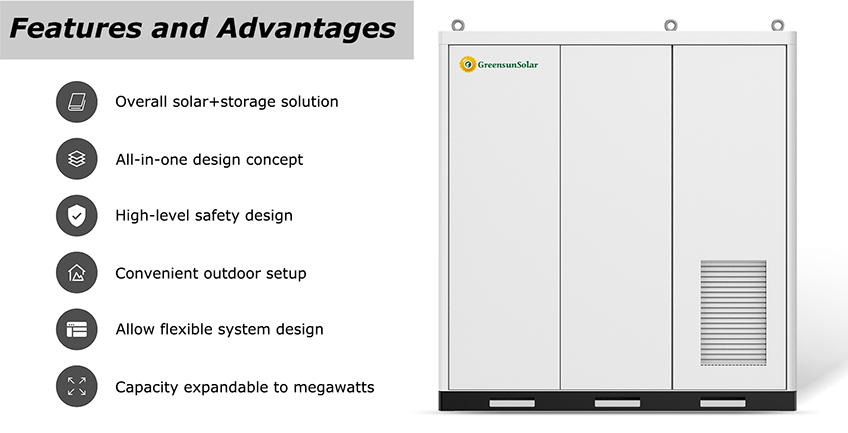
GREENSUN outdoor energy storage cabinet design
Battery Energy Storage Costs and ROI
Upfront Cost vs. Total Cost of Ownership
A low purchase price does not tell you much about the long-term value of an energy storage system. Compare the upfront investment against the total cost of ownership, taking into account system lifespan, maintenance, replacement requirements, and operating performance. BESS capital expenditure generally includes the battery system on the DC side, power conversion systems, civil infrastructure, installation, and other balance-of-system equipment. The actual cost distribution varies by project size, system design, location, and supplier.
| Cost Component | What to Consider |
|---|---|
| Battery system (DC side) | Battery cells, modules, racks, BMS, and battery enclosure |
| Power conversion systems | PCS or inverter capacity, conversion efficiency, and control functions |
| Civil infrastructure and installation | Foundations, electrical work, site preparation, and commissioning |
| Annual maintenance | Inspection, monitoring, servicing, and component replacement |
| End-of-life and decommissioning | Battery removal, recycling, disposal, and site restoration |
Battery lifespan changes the financial calculation. Lithium-ion systems can offer a long cycle life and relatively low routine maintenance requirements, although performance depends on chemistry, operating temperature, depth of discharge, and charging conditions. Lead-acid batteries generally have a lower initial purchase price but may require more frequent replacement in applications involving regular cycling. Flow batteries may be considered for certain large-scale, long-duration applications. Each technology has a different cost and operating profile, so the right choice depends on the project's duty cycle and financial objectives.
A GREENSUN energy storage cabinet with integrated PCS options can be evaluated as part of a complete commercial system. When comparing cabinet solutions, consider the battery capacity, inverter or PCS rating, cooling method, protection functions, installation requirements, warranty coverage, and service access. A system with a slightly higher initial price may provide better long-term value if it offers a more suitable configuration and lower operating costs.
Incentives, Financing, and Payback
Incentives can change the project budget significantly. In the United States, the Inflation Reduction Act introduced tax credit provisions for qualifying clean energy investments. The available credit rate and eligibility depend on the project type, applicable labor and apprenticeship requirements, domestic content provisions, energy community rules, and current tax regulations. Confirm the latest requirements with a qualified tax professional before including an incentive in your financial model. Financing generally follows three main paths:
-
Direct purchase using company funds, which gives the business direct ownership of the system.
-
Third-party financing through external lenders, with payments spread over the asset's operating life.
-
Developer financing, where a project partner provides the capital and shares the financial benefits through a power purchase agreement (PPA) or benefit-sharing arrangement.
Payback often depends heavily on demand charge reduction, especially for facilities with high peak loads. However, actual savings vary according to local electricity tariffs, load patterns, battery operating strategy, and system efficiency. In some markets, demand charges can represent a substantial portion of a commercial electricity bill. Additional revenue from grid services or utility performance programs may improve the financial case, but it should not be treated as guaranteed income. Model the project's own electricity bills, account for system degradation and operating costs, and test the financial results against possible changes in utility rates and incentive programs.
You now have a four-factor framework for selecting a lithium battery storage system: technical performance, application fit, compliance, and cost. Use all four factors together rather than allowing one specification or the lowest quotation to dominate your decision. A battery backup system sized for peak shaving may not provide the runtime your facility needs during an outage, while a low purchase price may hide limitations in warranty coverage or system integration. Build a shortlist of two or three suppliers, including GREENSUN, and request quotations based on the same project requirements. Ask each supplier to document system performance, certifications, inverter compatibility, warranty conditions, and estimated lifetime costs. A consistent comparison helps protect your budget and improve the long-term reliability of your energy storage investment.
FAQ
What Size Battery Do I Need for Peak Shaving?
Size the battery around your actual load data rather than using a general rule of thumb. Collect at least 12 months of interval data, then match the battery's power and energy capacity to your demand profile and electricity tariff structure. A 100 kWh lithium-ion battery may suit some smaller applications, while larger facilities may require a modular battery cabinet or high-voltage energy storage system. The final configuration depends on the required peak reduction, discharge duration, and operating schedule.
How Do I Choose Lithium Battery Storage System Vendors Fairly?
Compare complete systems using the same evaluation checklist. Ask each supplier for cycle life data, round-trip efficiency, product certifications, inverter compatibility, warranty terms, and after-sales service details. Request quotations based on identical technical requirements and project scope so you can compare performance, application fit, compliance, and total cost side by side.
Can a Battery Backup System Cover an Outage on Its Own?
Not automatically. A backup system may need a suitable transfer mechanism, dedicated backup panel, and an inverter capable of supporting the required loads. The inverter's power rating and your load priorities determine which equipment can remain powered. Identify critical loads first, then confirm the battery capacity and runtime required during an outage.
Which Certifications Should a BESS Carry?
Relevant certifications may include UL 1973 for stationary battery applications, UL 9540 for the complete energy storage system, and IEC 62619 for industrial lithium-ion batteries. UL 9540A provides thermal runaway fire propagation test information, while NFPA 855 addresses installation requirements. GREENSUN offers LFP battery products with certifications such as TUV, IEC, CE, UL, and CSA, depending on the specific model. Always request the certificates that match the exact product and system configuration.
How Long Does a Commercial Storage Project Take to Pay Back?
Payback depends on electricity rates, demand charges, available incentives, system efficiency, battery degradation, and operating patterns. Demand charge reduction can be a major source of savings for some commercial facilities, but the financial result must be calculated using actual utility bills and load data. Treat additional grid service revenue as a potential benefit rather than guaranteed income, and test the model against changes in electricity prices and incentive programs.