8618715108506
 manager@greensunpv.com
 solar Greensun




Lithium batteries now power most new home solar storage installations. Homeowners choose a lithium battery because it is compact, efficient, and long-lasting. A lithium-ion battery for solar panels often reaches 90–95%+ round-trip efficiency and 2,000–5,000+ cycles. That efficiency makes the battery practical for daily solar storage.
Picking the right home solar battery for storage still takes care. You compare solar battery capacity, battery power, and battery voltage against your solar inverter, then review storage lifespan. You also weigh lithium-ion batteries against lead-acid and flow solar storage options. Then you check solar incentives for your solar energy storage system. GREENSUN builds lithium-ion and lead-acid solar storage products for home storage. This solar battery guide ends with a clear storage recommendation for most homes.
Key Takeaways
- Size your battery by usable energy, not just the label. Usable energy depends on depth of discharge and efficiency.
- Match the battery voltage to your inverter. Check the inverter's voltage range and communication protocol before you buy.
- Choose lithium iron phosphate (LFP) for most homes. It offers long life, high efficiency, and compact size.
- Claim federal and state incentives to reduce costs. The federal tax credit covers 30% of the installation cost.
- Verify safety certifications like UL 1973 and UN38.3. Check certificate numbers in public databases.
How to Choose a Lithium Battery: Key Specs
Battery Capacity and Usable Energy
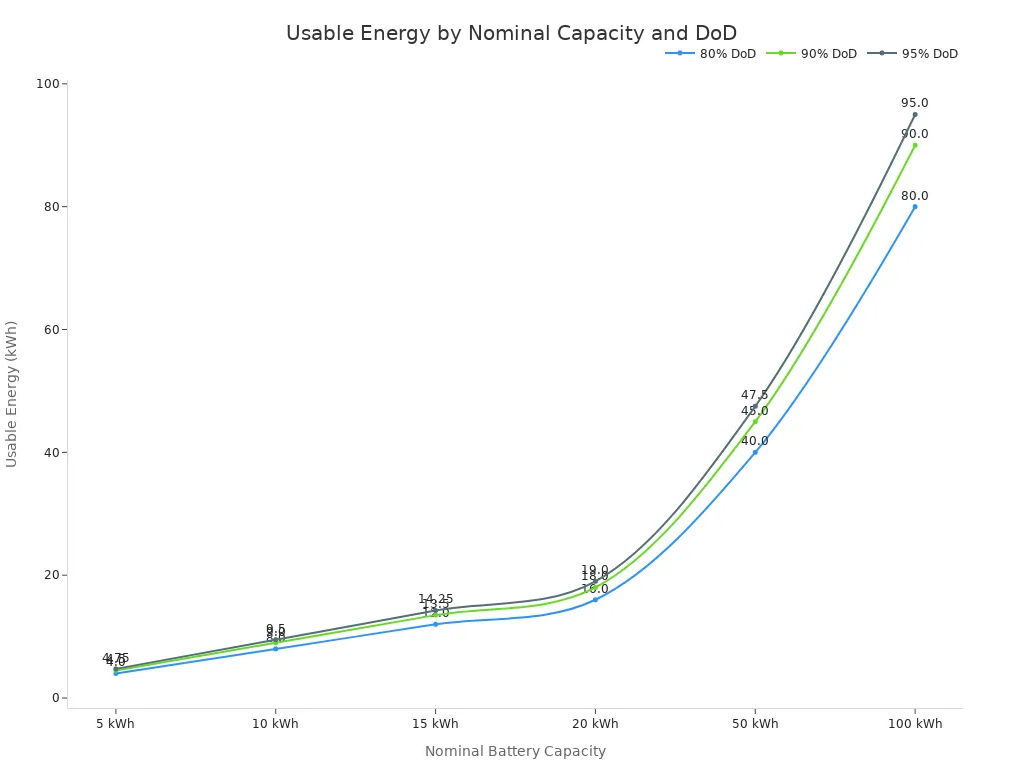
Battery capacity tells you how much energy a battery holds. Manufacturers rate this as nominal capacity under defined test conditions. Usable capacity is the energy you can actually draw in normal operation after operating limits and system losses. The difference matters when you choose a lithium battery for daily cycling.
Usable energy = nominal energy × depth of discharge × efficiency. A 10 kWh lithium battery at 90% depth of discharge delivers about 9 kWh before efficiency losses. With 15 kWh nominal, 90% depth of discharge, and 95% efficiency, you get roughly 12.83 kWh delivered.
| Nominal Capacity | 80% DoD | 90% DoD | 95% DoD |
|---|---|---|---|
| 5 kWh | 4.0 kWh | 4.5 kWh | 4.75 kWh |
| 10 kWh | 8.0 kWh | 9.0 kWh | 9.5 kWh |
| 15 kWh | 12.0 kWh | 13.5 kWh | 14.25 kWh |
| 20 kWh | 16.0 kWh | 18.0 kWh | 19.0 kWh |
Start sizing from your daily energy usage and your available solar input. Scale total capacity upward to cover the portion your battery cannot discharge. GREENSUN builds LFP storage in 12V, 24V, 48V, 51.2V, and high-voltage classes, including common 48V 100Ah lithium battery and 48V 200Ah formats for a solar system with battery backup.

GREENSUN 48V LiFePO4 battery for home solar storage.
Power Output and Round-Trip Efficiency
Power output sets how fast the battery delivers energy. Residential lithium solar batteries typically supply 3 to 11.5 kW continuous, with higher surge ratings for appliance start-up spikes. Check this figure against your peak household load.
Round-trip efficiency measures energy out versus energy in. Modern lithium-ion batteries reach 90% to 96%. LFP chemistry often exceeds 90–95%, while other chemistries sit at 70–85%. Higher round-trip efficiency means less solar energy lost in each cycle.
Depth of discharge also governs battery lifespan. Deeper discharge accelerates degradation. LFP cycle life runs about 8,000–12,000 cycles at 50% depth of discharge, 4,000–6,000 at 80%, and 2,000–4,000 at 100%. Most systems specify 80–90% usable depth of discharge as the practical balance.
Read the warranty as numbers, not phrases. Look for the term in years, the end-of-life capacity guarantee (often 60–80% of nominal), and the throughput or cycle limit. A 10-year term may end early once a 30 MWh throughput cap is reached. Confirm the "whichever comes first" basis and the operating conditions before you buy any solar battery.
Match Your Solar Battery to the System
Voltage, Connection Type, and Inverter Compatibility
Start with the connection type. Low-voltage systems wire batteries in parallel at 12V, 24V, 48V, or 51.2V. High-voltage systems stack modules in series for larger installations. Then match the battery to your inverter before you buy.
| Voltage Class | Typical Use | Key Trait |
|---|---|---|
| 12.8V | RV, marine, small backup | Simple, compact |
| 25.6V | Small off-grid systems | Lower current than 12V |
| 48V class | Residential solar, backup | Efficient, scalable |
| 51.2V | LiFePO4 solar storage | Common 16-cell architecture |
| High voltage | Commercial storage | Suited to larger systems |
GREENSUN builds LFP storage across these classes, including the lithium battery 48v 100ah and 48V 200Ah lithium battery formats common in home backup. Confirm four inverter figures: supported voltage range, maximum charge voltage, maximum charge current, and communication protocol such as CAN or RS485.

GREENSUN lithium battery option for larger home storage capacity.
A battery may have excellent capacity and cycle life, but it cannot safely operate with an inverter that does not support its voltage range. The battery's operating range must fall within the inverter's specified DC battery voltage range — never select a battery based only on the nominal voltage on its label.
Check the manufacturer's published compatibility list for brands like Deye, Sungrow, Growatt, and Sofar. This step prevents overheating, downtime, and costly trial-and-error purchases.
Safety, Size, and Installation Fit
Ask for the papers. UL 1973 covers battery-level abuse testing, UN38.3 covers transport, and ISO 9001 covers manufacturing quality. Verify the certificate number in the certifier's public database and confirm the model matches your quote.
Measure the space before delivery. Check enclosure rating, operating temperature limits, clearances from doors and vents, weight, and floor or wall strength. A licensed electrician should handle wiring, and your panel may need a backup subpanel. Review local permits and fire codes early.
Lithium-Ion Solar Batteries vs. Other Options
Lithium vs. Lead-Acid and Flow Batteries
You can compare the three main solar battery technologies on four practical points: space, efficiency, lifespan, and upfront cost. Lead-acid carries the lowest upfront price. It also needs the most room, because its energy density is low and a comparable bank is larger and heavier. Lead-acid round-trip efficiency sits around 70–80%, and its lifespan runs roughly 3–5 years, or about 1,000–2,000 cycles.
Flow batteries behave differently. Their electrolyte lasts 20+ years with minimal degradation, and you can scale capacity by adding tanks. Upfront cost is high, and energy density is lower than lithium-ion, so home-scale flow storage takes real space.
Lithium-ion batteries, especially lithium iron phosphate, pack high energy density into a compact case. Expect 10–15 years of life and low maintenance. The chemistry costs more at purchase, yet it delivers more usable kilowatt-hours per dollar over time.
| Feature | Lead-Acid | Lithium-Ion (LFP, NMC) | Flow Batteries |
|---|---|---|---|
| Lifespan | 3–7 years depending on usage | 5–20+ years; LFP offers high cycle counts | 20–30+ years potential; limited home-scale data |
| Cost | Low upfront, higher lifetime cost from replacements | Higher upfront, lower cost per usable kWh over time | High capital cost, especially at small scale |
| Size | Bulky and heavy | Compact and efficient | Low density; needs tanks |
| Depth of discharge | ~50–80% | Often 80–98% | Near or full |
A lithium-ion battery can cost up to double a comparable lead-acid bank. That battery cost gap shrinks once you count replacements, usable capacity, and the space you save.
Where Each Battery Type Fits Best
For most homeowners, LFP is the best fit. It balances performance, lifespan, and cost, and it suits daily solar cycling. GREENSUN supplies LFP storage alongside lead-acid options, so you can weigh each on its merits.
Lead-acid still earns a place. A tight budget or a basic solar system with battery backup can make it the sensible pick. One caution applies here.
If the budget is tight, or you need to install a basic solar system, then lead-acid batteries can be just as good. However, because environmental factors directly impact the performance and longevity of these batteries, be sure to weigh their features against expected consumption and climate.
Flow batteries fit very long-duration needs and larger installations. Their high capital cost and low density make them a poor match for a typical home. No single solar battery technology wins everywhere. Match the chemistry to your budget, your space, and your duty cycle, and the choice becomes clear.
Incentives and Solar Battery Payback
Federal, State, and Utility Programs
The federal Clean Energy Tax Credit covers 30% of your battery installation cost. You can claim it even without solar panels, as long as the battery holds at least 3 kWh, you own it, and you install it at your residence. File IRS Form 5695. The credit is nonrefundable, yet unused amounts typically roll over to future tax years. Confirm your eligibility with a tax professional before you count on it.
State and utility programs add more. California's SGIP pays $150–$1,000 per kWh, with equity bonuses for low-income customers in fire-prone areas. Hawaii's Battery Bonus pays HECO customers $850 per kW plus a monthly bill credit. Oregon offers $300 per kWh up to $2,500, and Minnesota pays $250 per kWh up to $7,000. Utility programs fall into three groups:
- Cash rebates with no contract or grid-sharing requirement
- Bring-your-own-battery programs that pay you for capacity during demand response
- Limited-enrollment pilot programs
Check your state energy office page and your utility's program page, then verify details with your installer.
Estimating Your Break-Even Timeline
Payback math is simple. Subtract incentives from your upfront cost, then divide by annual bill savings. Savings vary widely by location and usage. A Stanford study found that solar-plus-storage savings differ by state, county, and even household. Typical annual bill reductions range from 60% to 80%, depending on rates and usage patterns.
Payback period equals net cost divided by annual savings. Net cost is total system cost minus tax credits and rebates. Annual savings combine electricity bill savings and any SREC income.
One Arizona example: $23,405 in solar costs minus a $1,000 state credit leaves $22,405. Monthly savings of $144 become $1,728 per year. Payback is $22,405 ÷ $1,728, or about 12.97 years. Run this calculation with your own quotes, and ask GREENSUN or your installer for a solar system with battery sized to your usage.
Size your solar battery by usable battery capacity and battery lifespan, confirm voltage and inverter compatibility, compare battery cost per usable kilowatt-hour, and factor in solar incentives.
Most homeowners should choose a lithium battery, and lithium iron phosphate is the strongest pick: long lifespan, compact build, reliable daily solar cycling. Lead-acid batteries fit tight budgets, and flow chemistry suits very long-duration solar storage.
To choose a lithium battery wisely, gather quotes from solar installers, ask each to size a solar system with battery to your usage, and verify solar incentive eligibility. GREENSUN builds lithium-ion batteries and solar batteries, so you can compare lithium-ion with lead-acid. Explore the company's 48V 100Ah LiFePO4 battery range to compare available battery formats.
FAQ
How Much Usable Capacity Does a Home Need?
Start with your daily energy use. Size the solar battery by usable capacity, not the label. Most homes land between 80% and 90% depth of discharge. A solar system with battery backup should cover your evening load. GREENSUN can size a battery to your usage, your solar input, and your solar panels.
Which Voltage Class Should You Choose?
Match the voltage to your inverter. Common classes are 12V, 24V, 48V, 51.2V, and high voltage. Home backup often uses a lithium battery 48v 100ah or lithium battery 48v 200ah format. GREENSUN builds LFP storage in each class for a solar system with battery.
Will Lithium-Ion Batteries Work With Your Inverter?
Check the compatibility list first. Lithium-ion packs must sit inside the inverter's DC voltage range. Confirm the protocol, such as CAN or RS485. A lithium battery with the right voltage still fails without protocol support, and your solar installer should confirm the pairing of the solar battery.
How Long Does a Lithium-Ion Battery Last?
Expect 10 to 15 years in daily cycling. LFP chemistry holds 4,000–6,000 cycles at 80% depth of discharge. Read the warranty for years plus a throughput cap. A pack that meets both limits protects your investment. A solar battery sized this way lasts.
What Paperwork Should You Request?
Ask for UL 1973, UN38.3, and ISO 9001 certificates. Verify each certificate number in the certifier's public database. Confirm the model on the certificate matches your quote. A solar battery without papers is a risk, and lithium-ion batteries from major brands should list inverter partners for solar storage.