8618715108506
 manager@greensunpv.com
 solar Greensun




Most U.S. homes need a 6–8 kW solar system, which works out to roughly 15–24 solar panels and about 300–500 sq ft of roof space. That range is a starting point, not a verdict. Your electricity use, your location, and your goals decide where you land inside it.
Maybe your bills keep climbing. Maybe your roof is smaller than you hoped, or your budget feels tight. Perhaps you worry about buying too much capacity or too little. All of these concerns are valid, and they all have answers.
You can choose the right solar system size with a simple, step-by-step method. This guide walks you through the math, the key factors, and the costs behind a solar panel system, with support from suppliers like Greensun.
Key Takeaways
- Calculate your daily electricity use and local sun hours to estimate system size.
- Most homes need 16 to 23 panels, but roof space and shade can change the count.
- System costs drop per watt as size grows, and federal tax credits cover 30%.
- Plan for future energy needs like electric vehicles to avoid oversizing later.
- If your roof is too small, community solar offers savings without installation.
Run Your Solar Panel Calculation
Gather Usage and Sun Hours
Every solar panel calculation starts with two numbers: how much power you use and how much sun you get. Grab twelve months of utility bills. The U.S. Energy Information Administration reports the average residential customer used 10,791 kWh in 2022, and the EIA puts typical household annual electricity usage near 10,500 kWh. Your own bills beat any average, so add up your monthly figures to get your true annual electricity usage. Divide that total by 12 if you want your average monthly kWh usage for comparison.
Next, look up peak sun hours for your zip code. These hours measure usable sunlight intensity, not daylight length. The national average sits near 5.0 per day, but the spread is wide.
| Region | Average Peak Sun Hours/Day |
|---|---|
| Pacific Northwest & Northeast | ~4.0 |
| Midwest & Southeast | ~5.0 |
| Desert Southwest | ~6.5 |
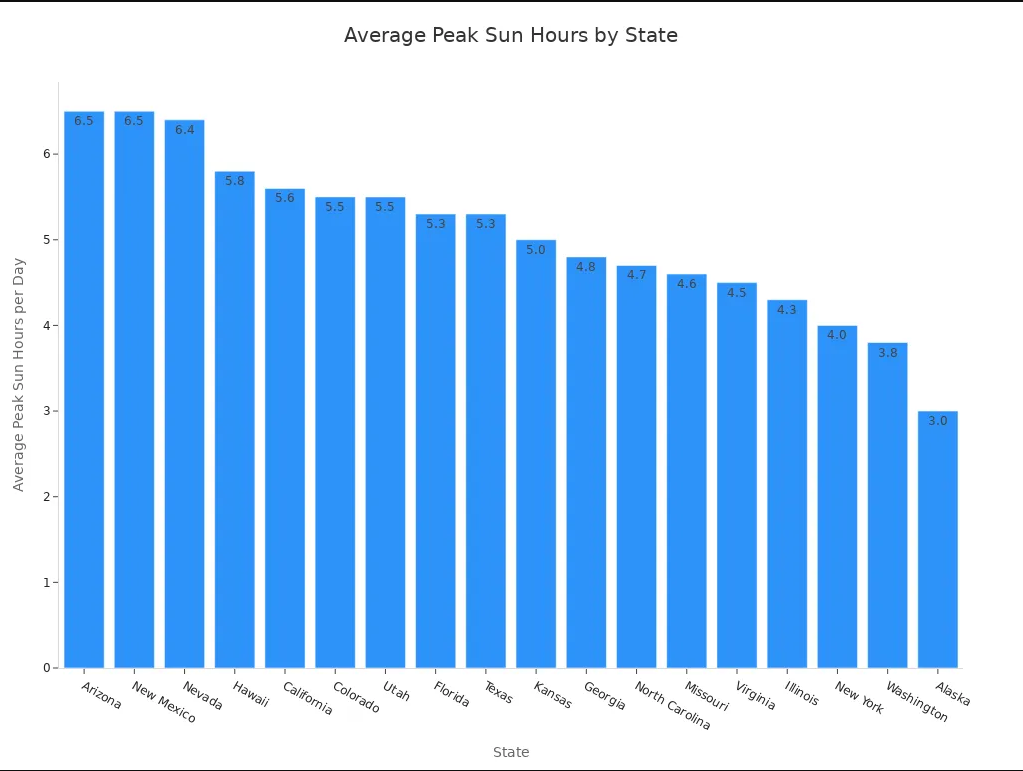
Arizona averages 6.5 peak sun hours, while Washington gets 3.8 and Alaska just 3.0. Winter output runs roughly 25–50% below the yearly figure, so plan for seasonal dips.
The Seven-Step Math
Here is how to size a solar system on paper:
- Find your annual electricity usage in kWh from those bills.
- Divide by 365 for daily kWh. At 10,791 kWh, that is about 29.6 kWh per day.
- Look up peak sun hours for your location.
- Base system size = daily kWh ÷ peak sun hours. At 5.0 hours, 29.6 ÷ 5.0 = 5.92 kW.
- Add inefficiency headroom. A 20% buffer is standard practice:
A 20% headroom is recommended to account for inefficiencies. Multiply the solar array size by 1.2 (120%) to apply this: 6 kW × 1.2 = 7.2 kW solar array.
- Pick an offset percentage. Full offset covers 100% of annual energy use; a partial offset of 70–80% trims cost while still cutting bills.
- Convert to panel count. Divide system size by panel wattage. Size is stated as DC wattage, so ten panels rated at 400W equal a 4 kW DC system.
That gives you a solid estimate for the number of solar panels needed. Installers then run specialist solar quoting software to finalize solar system sizing, model shading, and project savings. Suppliers like Greensun offer free design services and one-stop configurations, from a 5kW solar system up to a 10kW solar system, to help you choose the right solar system size with confidence.

How Many Solar Panels Do I Need for My Home?
You now have a system size in kilowatts. The next question is how many solar panels do I need for my home in actual panel count. Most U.S. households land between 16 and 23 panels when they aim to cover all their annual electricity usage. That range assumes 440 W panels and a production ratio between 1.1 and 1.6, where the ratio compares yearly kWh output to system wattage.
| Parameter | Value |
|---|---|
| Average U.S. household annual electricity use | 10,791 kWh (about 900 kWh/month, per EIA) |
| Assumed offset target | 100% of electricity usage |
| Solar panel wattage used | 440 W |
| Production ratio range | 1.1 to 1.6 |
| Calculation | 10,791 kWh ÷ (1.1 or 1.6) ÷ 440 W |
| Resulting panel count | 16 to 23 panels |
The math is simple: 10,791 kWh divided by the production ratio, then divided by 440 W. A mild, sunny climate pushes you toward the low end. California, at a ratio of 1.5, needs about 17 panels, or a 7.5 kW system. Massachusetts, at 1.1, needs about 23 panels, or 10.1 kW. Same bills, very different array.
Sunlight, Panel Wattage, and Roof Space
Three things move the number of solar panels needed. First, how much sunlight does your roof get? Shade from trees, a north-facing slope, or a chimney all cut production, so you add panels to compensate. Second, panel wattage and efficiency matter. Higher-wattage panels shrink the count for the same system size. Third, roof space and orientation set a hard ceiling. A cramped or shaded roof may cap the size of your solar panel array below your target. Compare available solar panels for sale and their rated wattages when estimating the number of modules that will fit.
Plan for Future Energy Needs
Think ahead before you lock in the ideal number of solar panels. An EV in the driveway or a new air conditioner will raise your annual energy use later. You can size for that now, or leave room to expand. A practical middle path: build a solar panel system that matches today's usage, then confirm the inverter and mounting layout can handle extra panels down the road. That protects your budget without oversizing today. Suppliers like Greensun design on-grid, off-grid, and hybrid configurations, from a 5kW solar system upward, and their free design service helps you choose the right solar system size for both current and future demand.
A quick sanity check helps here. Compare your recommended number of solar panels against your usable roof area. If the count fits with room to spare, you have flexibility. If it barely fits, plan for a partial offset instead.
Costs and Incentives by System Size
Price Ranges by Size
Cost scales with capacity, yet the price per watt tends to fall as the array grows. Installers spread labor, permitting, and design work across more panels, so bigger jobs carry a lower unit rate. Recent market data shows installed costs of roughly $2.50 to $3.30 per watt, with an average quote near $2.75 per watt before incentives.
| System Size | Average $/W | Average System Cost (Before Incentives) |
|---|---|---|
| 6 kW | $2.68/W | $16,080 |
| 8 kW | $2.62/W | $20,960 |
| 10 kW | $2.58/W | $25,800 |
A 6 kW solar panel system suits modest households, while a 10 kW solar system fits larger homes or families planning for an EV. Both are valid choices. Your usage and roof space decide which one pays off. A 5kw solar system can still deliver strong savings for a smaller home with efficient appliances.
Federal, State, and Utility Incentives
The federal Residential Clean Energy Credit covers 30% of qualified costs for systems installed from 2022 through December 31, 2025. It has no annual or lifetime dollar limit, apart from fuel cell property.
The federal solar tax credit is currently fixed at 30%, and there is no limit on the amount you can claim, though it applies only to eligible expenses.
State and utility programs add more. Property tax exemptions exist in 36 states, sales tax exemptions in 22, and rebate programs in 17. Net metering credits excess power in many states. These programs shift by location, so check your state's current rules before you choose the right solar system size.
One-stop suppliers such as Greensun offer free design services and customized configurations, including on-grid, off-grid, and hybrid setups. That kind of support helps you compare a solar energy system 10kw option against smaller builds without guesswork.

Scenarios and Alternatives
How Many Solar Panels You Need to Power Your House
Appliance load gives you a second way to estimate how many solar panels you need to power your house. Heating and cooling drive the biggest share of U.S. household energy consumption. A 3-ton central AC draws roughly 3,000–3,500W, which takes 10–14 panels at 400W. A 12,000 BTU mini-split needs only 4–6 panels. Add up your big loads, then compare that count to your bill-based estimate.
Here is the shortcut installers use:
Solar Panels Needed = (AC Wattage × Hours Used Per Day) ÷ (Panel Wattage × Sun Hours × 0.8 Efficiency)
In a region with about 6 peak sun hours, covering an 8,340 watt-hour daily load takes roughly 21 panels. That figure answers how many solar panels do I need for a typical home with AC. Budget-conscious readers can size a partial offset instead and still cut bills. Greensun's free design service helps you compare a 5kW solar system against a 10kW solar system before you commit.
When Your Roof Is Too Small
Roof area sets a hard limit on the number of solar panels needed. A typical panel takes about 17.5 sq ft, and most homes need 300–500 sq ft of clear roof. A small home may fit a system in about 200 sq ft; a larger home can need more than 1,000 sq ft. If shading or a steep pitch shrinks your usable space, the recommended number of solar panels may not fit.
Community solar fills that gap well. You subscribe to an off-site solar farm and pay a discounted rate, with no roof required and no upfront cost. Savings typically run 5–20% on annual electricity bills. Rooftop solar usually delivers larger lifetime savings and ownership benefits, so it remains the stronger fit when your roof allows it. Community solar suits renters and shaded properties best.
Either path changes your electricity usage profile, so match the option to your site. Greensun supports both conversations with free design help for any solar panel system.
Accurate sizing protects your budget and maximizes your savings. Undersize the array and you lose production; oversize it and you pay for capacity you never use. The seven-step method gives you a solid starting estimate, so run the math before you talk to anyone.
Real-world sizing still involves roof specifics, shading, and local rules. Use a professional solar calculator or book a free consultation to choose the right solar system size with confidence. Suppliers like Greensun offer free design services and one-stop customized solutions, an example of the personalized support that helps you size a solar system properly.
FAQ
What size solar panel system does the average home need?
Most U.S. homes land in the 6–8 kW range. That covers typical annual usage of about 10,791 kWh. Your own bills and local sun hours decide where you fall inside that range. A smaller home may do well with a 5kw solar system, while a larger one may need more.
How many solar panels you need depends on what?
Three things drive the count: your annual electricity usage, your peak sun hours, and your panel wattage. Most households need 16–23 solar panels at 440 W each. Shade and roof orientation can push that number higher, so check your site first.
Can I start smaller and add solar panels later?
Yes. Size the array to today's usage, then confirm the inverter and mounting layout can handle extra capacity. This keeps your budget in check. A 10kw solar system leaves more room to grow than a smaller build, especially if an EV is coming.
Do I need a full offset to save money?
No. A partial offset of 70–80% still cuts your bills and lowers upfront cost. Full offset maximizes lifetime savings when roof space allows. Match the offset to your budget and your roof, not to a slogan.
What if my roof cannot fit the array I need?
Community solar is a solid fallback. You subscribe to an off-site farm and save roughly 5–20% on annual bills, with no roof required. Rooftop solar usually delivers larger lifetime savings, so use community solar when space or shade blocks it. Greensun's free design service can help you compare options.