8618715108506
 manager@greensunpv.com
 solar Greensun




Choosing high-wattage solar panels for a commercial project involves more than comparing the wattage printed on a module label. For factories, warehouses, commercial buildings, and large-scale solar installations, the right photovoltaic modules must balance power output, conversion efficiency, installation space, structural requirements, and long-term operating costs.
As solar technology continues to advance, commercial buyers have more options, including 600W, 650W, 685W, and 700W+ solar panels. N-type TOPCon technology, half-cut cells, and bifacial double-glass designs are also becoming important considerations when selecting modules for large installations.
So, how should businesses choose high-wattage solar panels for commercial projects? The most practical approach is to evaluate the project requirements first and then compare module specifications, system compatibility, and expected energy production. This guide explains the key factors commercial buyers should consider, with examples of solar panel solutions available from GreenSun PV.
Why High-Wattage Solar Panels Are Important for Commercial Projects
Commercial solar installations often involve large electricity demands and limited installation space. A factory rooftop, logistics center, shopping complex, or industrial facility may need hundreds of solar modules to achieve its target system capacity.
High-wattage solar panels can help reduce the number of modules required to reach a specific installed capacity. This may simplify module handling, mounting arrangements, and electrical connections, depending on the project design.
For example, a 1MW DC solar array would require approximately:
- 1,852 modules rated at 540W.
- 1,538 modules rated at 650W.
- 1,460 modules rated at 685W.
- 1,370 modules rated at 730W.
These figures are illustrative calculations based on module rated power and do not include system losses or installation constraints. They show why higher-wattage modules can be attractive for large commercial installations.
However, fewer panels do not automatically mean a lower total project cost. Module dimensions, mounting structures, inverter compatibility, transportation, and installation requirements must also be considered.
Choose the Right Wattage Based on Project Requirements
One of the first decisions is determining the appropriate module power range. Commercial solar projects have different roof conditions, energy consumption patterns, and installation budgets, so there is no single wattage that works best for every application.
For medium-sized commercial rooftops, 550W to 600W modules may provide a practical balance between module dimensions and power output. For larger industrial rooftops and ground-mounted solar farms, 650W to 700W+ modules may be worth considering when the installation structure and electrical design support them.
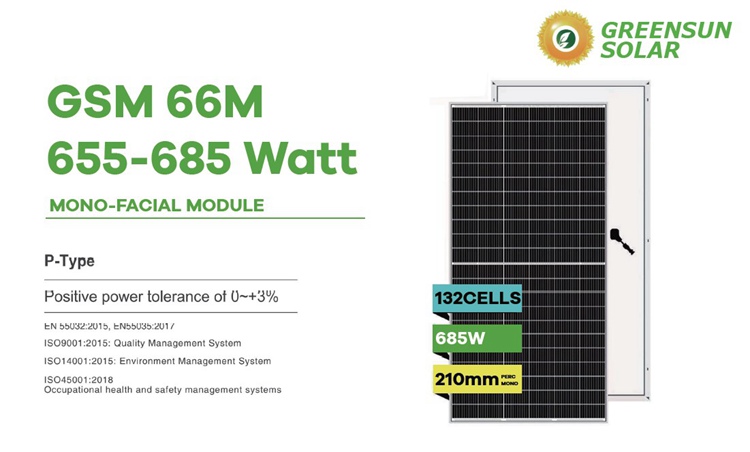
GreenSun PV offers several high-power module options, including 650W, 660W, 670W, 680W, and 685W monocrystalline half-cut solar panels. Its product range also includes N-type TOPCon and bifacial modules in higher power classes.
For projects requiring large-format modules, buyers can explore the 650W–685W monocrystalline solar panel to review its specifications and module dimensions.
When comparing wattage options, buyers should also calculate the total number of modules needed, available installation area, and expected DC system capacity. A slightly lower-wattage module may sometimes provide a better overall fit if its dimensions and electrical characteristics suit the project more effectively.
Compare Module Efficiency Instead of Looking at Wattage Alone
Rated power indicates how much electricity a solar panel can produce under standard test conditions. Module efficiency, on the other hand, describes how effectively the panel converts incoming sunlight into electrical power over its surface area.
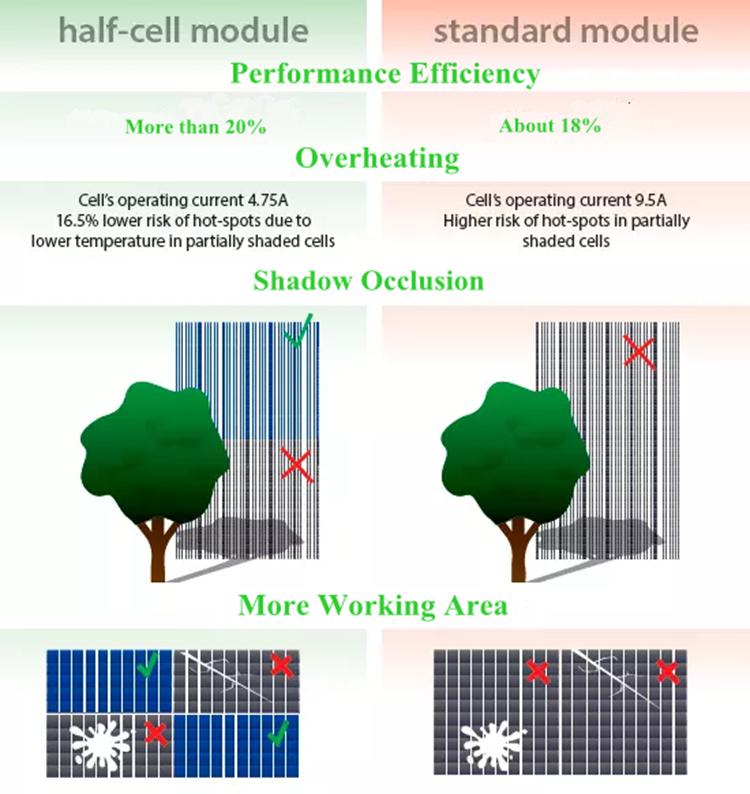
This distinction is particularly important for commercial rooftops where usable installation space is limited. A higher-efficiency module can generate more power from a given roof area, potentially helping businesses maximize installed capacity without expanding the available space.
When comparing high-wattage solar panels, buyers should review the following specifications:
- Rated power (Pmax): The module's nominal output under standard test conditions.
- Module efficiency: The percentage of sunlight converted into electrical energy.
- Temperature coefficient: Indicates how power output changes as module temperature increases.
- Power tolerance: Shows the permitted variation from the rated output.
- Annual degradation: Helps evaluate how module performance changes over its operating life.
For example, GreenSun PV's 685W half-cut monocrystalline module has a listed module efficiency of 22.1%, a maximum power output of 685W, and a power temperature coefficient of -0.350%/°C. These specifications provide useful reference points when comparing modules for commercial installations.
Businesses looking for newer cell technology can also explore N-type solar panels, including TOPCon options designed for high-efficiency photovoltaic applications.
Consider N-Type TOPCon Technology for Long-Term Performance
N-type TOPCon solar panels are increasingly considered for commercial and utility-scale projects because of their high conversion efficiency and potential for improved energy yield over the operating life of a system.
Compared with conventional P-type technologies, N-type TOPCon modules generally offer several advantages:
- High conversion efficiency, helping maximize output from limited installation space.
- Lower light-induced degradation characteristics.
- Good performance potential in different operating environments.
- Availability in high-power module formats suitable for large installations.
However, the actual performance difference depends on the specific module design, manufacturer specifications, operating temperature, installation conditions, and product quality.
For commercial buyers, it is important to compare the complete technical datasheet rather than selecting a panel based on its technology name alone. Pay particular attention to the power temperature coefficient, degradation warranty, operating temperature range, and independently verified certifications.
GreenSun PV provides N-type TOPCon and other advanced photovoltaic module options for different project requirements. Buyers can compare available models through its solar panel and photovoltaic product range.
Check Panel Dimensions, Weight, and Installation Conditions
A high-wattage solar panel is often physically larger than a lower-power module. This means that module dimensions and weight can directly affect commercial project planning.
For example, GreenSun PV's 650W–685W half-cut monocrystalline module has the following listed specifications:
- Maximum power: 685W.
- Cell configuration: 132 half-cut cells.
- Cell size: 210 × 210mm.
- Module dimensions: 2400 × 1303 × 35mm.
- Module weight: 36kg.
- Module efficiency: Up to 22.1%.
These dimensions are important when evaluating whether the panels can be installed safely and efficiently on a commercial rooftop or ground-mounted structure.
Before purchasing, project developers should confirm the following:
- Whether the roof can support the additional dead load and applicable wind and snow loads.
- Whether the module dimensions fit the available mounting layout.
- Whether the mounting system is compatible with the module's frame and clamp zones.
- Whether transportation and lifting equipment can handle the module size and weight.
- Whether sufficient maintenance access and safety clearances can be maintained.
For large industrial rooftops, a structural assessment should be completed before finalizing the module selection. Choosing a higher-wattage panel without checking the roof's structural capacity can create unnecessary installation risks.
Evaluate Bifacial Solar Panels for Suitable Commercial Sites
Bifacial solar panels can generate electricity from both the front and rear sides of the module. While the front side receives direct sunlight, the rear side can capture reflected and scattered light from the surrounding surface.
This technology can be particularly useful for commercial ground-mounted installations, solar farms, and certain rooftop projects where the mounting arrangement and surrounding surfaces allow sufficient light to reach the rear of the modules.
The additional energy gain from bifacial modules depends on several factors:
- Ground albedo: Light-colored surfaces generally reflect more sunlight than dark surfaces.
- Mounting height: Adequate clearance can improve rear-side light exposure.
- Module spacing: Proper spacing can reduce rear-side shading.
- Installation structure: Mounting rails and other components can affect rear-side irradiance.
- Site conditions: Dust, surrounding buildings, and nearby obstacles may influence performance.
It is important to remember that bifacial modules do not automatically produce a fixed percentage of additional electricity. The actual gain should be estimated using project-specific conditions and an appropriate energy simulation.
For projects where rear-side generation is practical, buyers can review GreenSun PV's bifacial double-glass solar modules to compare available product configurations.
Make Sure the Solar Panels Match the Inverter
High-wattage solar panels must work efficiently with the selected inverter. Even when a module offers excellent power output, an incompatible electrical configuration can limit system performance or create design problems.
Commercial project developers should compare several electrical parameters before finalizing the system design:
- Open-circuit voltage (Voc): The maximum module voltage under open-circuit conditions.
- Maximum power voltage (Vmp): The voltage at which the module delivers its rated maximum power.
- Short-circuit current (Isc): The current produced under short-circuit conditions.
- Maximum power current (Imp): The current delivered at the module's maximum power point.
- Maximum DC input voltage: The inverter's permitted PV input voltage.
- MPPT operating range: The voltage range within which the inverter can track maximum power.
For example, the listed 685W GreenSun module has a Voc of 46.35V, a Vmp of 39.13V, and an Imp of 17.50A. These values should be checked against the inverter specifications and the expected lowest and highest operating temperatures.
Designers must also account for the maximum number of modules connected in series, parallel-string current limits, and applicable electrical regulations. Cold-weather open-circuit voltage calculations are particularly important because module voltage increases as temperature decreases.
For commercial grid-connected installations, GreenSun PV provides on-grid solar power systems that can be configured according to project capacity and grid requirements.
Consider Energy Storage for Commercial Solar Applications
Not every commercial building uses electricity at the same time solar panels generate the most power. Factories, warehouses, and commercial facilities may have different daytime and evening consumption patterns.
Adding battery storage can help businesses use more of their generated solar electricity. Depending on the electricity tariff and system configuration, stored energy may also support peak-demand management, backup power, and improved energy flexibility.
When evaluating a commercial solar-plus-storage project, buyers should consider:
- Daily electricity consumption and peak demand.
- Available solar generation during operating hours.
- Battery capacity and continuous charge/discharge power.
- Inverter compatibility and system communication.
- Backup requirements and critical electrical loads.
- Battery operating temperature, safety features, and warranty conditions.
GreenSun PV offers commercial and industrial energy storage solutions alongside photovoltaic modules and solar power systems. Businesses planning a complete solar installation can explore its commercial and industrial energy storage systems when evaluating solar-plus-storage configurations.
Compare Product Certifications, Warranty, and Supplier Reliability
Commercial solar projects are long-term investments. Therefore, the reliability of the manufacturer and the supporting product documentation are just as important as the initial module price.
Before placing a bulk order, buyers should request and review:
- Product datasheets with complete electrical and mechanical specifications.
- Applicable IEC, CE, TÜV, UL, or other market-specific certification documents.
- Product warranty and linear power performance warranty terms.
- Manufacturing quality control and inspection procedures.
- Flash test reports and traceability information for supplied modules.
- Packaging, transportation, and delivery arrangements.
Certification requirements vary by destination market and project type, so buyers should verify that the actual model and production configuration are covered by the documents supplied.
Supplier experience also matters. A manufacturer with established production capacity, technical support, and export experience can make procurement and project coordination more manageable.
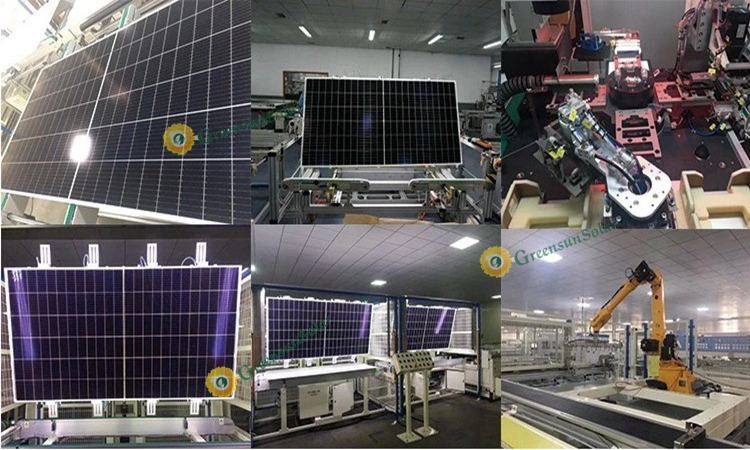
GreenSun Solar Energy Tech Co., Limited was established in 2003 and provides photovoltaic modules, solar power systems, batteries, and commercial energy solutions. Its website also describes manufacturing capacity and product certification information that commercial buyers can review during supplier evaluation.
Calculate the Total Cost Instead of Comparing Panel Prices Alone
The lowest module price does not necessarily produce the lowest overall project cost. Commercial solar buyers should evaluate the total installed cost and the expected electricity generation over the system's operating life.
A useful comparison includes:
- Module purchase price and transportation costs.
- Mounting structures and installation labor.
- Inverters, cables, connectors, and electrical protection equipment.
- Engineering, structural assessment, and permitting costs.
- Operation, cleaning, inspection, and maintenance expenses.
- Expected annual energy production and electricity savings.
For example, a higher-wattage module may reduce the number of panels required for a target DC capacity. However, if the module is substantially larger or heavier, the mounting and handling costs may offset some of those savings.
Similarly, a bifacial module may offer additional generation potential, but the economic benefit depends on site reflectivity, mounting design, and actual rear-side irradiance.
For this reason, commercial buyers should compare estimated lifetime energy production and total system cost rather than choosing a solar panel based solely on its price per watt.
Which High-Wattage Solar Panels Are Suitable for Different Commercial Projects?
The most suitable module depends on the installation environment and the project's main objective. The following comparison provides a practical starting point for commercial buyers.
| Project Type | Suggested Module Range | Main Consideration |
|---|---|---|
| Commercial rooftops | 550W–685W | Roof loading, usable area, and module layout |
| Large industrial rooftops | 650W–700W+ | High power density and structural compatibility |
| Ground-mounted solar farms | 650W–750W+ | Land utilization, mounting design, and bifacial potential |
| Commercial solar-plus-storage | 550W–750W+ | Generation profile, battery sizing, and inverter matching |
These ranges are indicative rather than fixed design rules. Final module selection should be based on project-specific engineering calculations, site conditions, and the electrical design.
For a complete commercial installation, GreenSun PV can provide photovoltaic modules alongside grid-connected, hybrid, and energy storage solutions. This allows buyers to evaluate the solar panels and supporting equipment as part of an integrated system rather than as separate purchases.
How to Choose the Right High-Wattage Solar Panel Supplier
Finding a suitable supplier is an important part of commercial solar procurement. Buyers should look beyond product advertisements and assess whether the manufacturer can support the technical, quality, and delivery requirements of the project.
Before confirming an order, ask the supplier these questions:
- Can the manufacturer provide the required wattage and module configuration?
- Are complete datasheets and valid certification documents available?
- Can the supplier support bulk orders and project-specific requirements?
- Are product quality inspections and shipment checks available?
- Can the supplier assist with inverter matching and system configuration?
- Are warranty terms, delivery schedules, and after-sales support clearly defined?
For developers and distributors sourcing high-wattage photovoltaic modules, GreenSun PV offers a range of monocrystalline, N-type TOPCon, HJT, and bifacial solar panels, together with commercial solar power and energy storage solutions.
Rather than selecting a module based only on its rated wattage, buyers can share their project capacity, installation location, available space, and energy requirements with the GreenSun team to identify a suitable product configuration.
Frequently Asked Questions About High-Wattage Solar Panels for Commercial Projects
What wattage solar panels are best for commercial projects?
There is no universal best wattage for every commercial project. Modules rated between 550W and 750W+ are worth evaluating for many large installations. The final choice depends on roof space, structural capacity, module efficiency, inverter compatibility, and project economics.
Are 700W solar panels better than 600W solar panels?
A 700W solar panel produces more rated power per module than a 600W panel under standard test conditions. However, it may also have larger dimensions and greater weight. The better option depends on the available installation space, mounting structure, and overall system design.
Why are N-type TOPCon solar panels suitable for commercial installations?
N-type TOPCon modules offer high conversion efficiency and favorable degradation characteristics, making them attractive for commercial and utility-scale applications. Buyers should compare temperature coefficients, degradation warranties, and complete datasheets before selecting a specific model.
Do bifacial solar panels generate more electricity?
Bifacial solar panels can generate additional electricity by capturing reflected and scattered light on their rear side. The actual gain depends on ground reflectivity, mounting height, module spacing, and shading conditions. The additional generation should be calculated for each project rather than assumed to be a fixed percentage.
How many 685W solar panels are needed for a 1MW solar project?
Approximately 1,460 modules rated at 685W are needed to achieve 1MW of DC installed capacity. The calculation is 1,000,000W divided by 685W per module. The final quantity may change depending on the target system size, project layout, and equipment configuration.
What should buyers check before purchasing high-wattage solar panels in bulk?
Buyers should check rated power, module efficiency, dimensions, weight, electrical parameters, temperature coefficients, product certifications, warranty terms, quality inspection reports, and delivery arrangements. Compatibility with the mounting structure and inverter is also essential.
Can high-wattage solar panels be used with commercial battery storage systems?
Yes. High-wattage solar modules can be integrated into commercial solar-plus-storage systems when the inverter, battery, DC voltage, current limits, and system controls are properly designed. Battery capacity should be selected according to the facility's electricity consumption and storage objectives.
Does GreenSun PV provide complete commercial solar solutions?
Yes. GreenSun PV provides photovoltaic modules, on-grid and hybrid solar systems, and commercial and industrial energy storage solutions. Buyers can discuss project capacity, installation conditions, and technical requirements with the company to evaluate a suitable configuration.
Choose the Right Solar Solution for Your Commercial Project
Selecting high-wattage solar panels is a technical and economic decision. The right module should provide an appropriate balance of power output, efficiency, physical dimensions, electrical compatibility, product reliability, and long-term value.
Whether you are planning a factory rooftop installation, a commercial solar power system, or a large ground-mounted solar project, GreenSun PV offers a range of high-power photovoltaic modules and supporting solar energy solutions.
Contact GreenSun PV to discuss your project requirements, compare available module specifications, and identify a suitable high-wattage solar panel solution for your commercial application.